breadcrumb
Content SDK component is missing React implementation. See the developer console for more information.
SWITCHGEAR DESIGN
Your main power supply is aging if it is over 20 years old. If this is the case, the chances are it is not safe and could be past it’s use by date. The projected life of 11 kV oil filled switchgear was anticipated to be 25 years; materials were chosen with that in mind. Almost all bulk oil switchgear in Australia is well beyond its original 25 year design life. Bulk oil circuit breakers, principally supplied by UK manufacturers ceased to be installed on or after 1985 when the manufacturers were either taken over or closed down. There are hundreds if not thousands of these circuit breakers still in service.
RISKS ASSOCIATED WITH BULK OIL CIRCUIT BREAKERS
The potential for an arc flash occurrence, or an internal arc in switchgear, is not confined to bulk oil switchgear. However, the consequences with bulk oil switchgear are usually much more severe, due to the risk of fire.
Failure of a single breaker can cause a fire which can destroy the whole main switchboard, damaging the building containing the switchroom and damaging the ends of the incoming and distributing cables.
The cost of the loss of the main switchboard may be insignificant compared to:
- Personal injury (severe burns, electric shock)
- Loss of Life (possibly many deaths in public buildings, shopping centres, cinemas and the like)
- Economic loss if the business cannot carry on its activities
- Cost to repair fire and smoke damage
BULK OIL CIRCUIT BREAKER FAILURE CAUSES
Circuit breakers can fail for a number of reasons. The principle causes are:
- Faulty installation
- Overloading
- Insufficient or improper maintenance
- Age and obsolescence
- Fault level capacity
Faulty installation may not be detected until many years after the commissioning of the installation. The risk of fire and explosion can easily be caused by filling the switchgear with the wrong type or wrong amount of oil. Too much oil can overpressure the oil tanks, causing them to rupture under fault conditions. Too little oil can cause the oil to inadequately quench the arc caused by ‘normal’ switching operations, igniting the oil and causing a fire.
OVERLOADING
Switchgear installed up to 50 years ago will have been overloaded during that period. The overload may have been cyclic – daily electrical overload use at peak times followed periods of low load, or high overload caused by fault clearing, switching operations and network operations. Whatever the cause of the overloading - it results in the reduction of the life of the switchgear and the increase in the probability of failure.
INSUFFICIENT OR IMPROPER MAINTENANCE
The ‘aging population’ is diminishing the availability of skilled labour. Most of the engineers and tradesmen familiar with bulk oil switchgear have nearly all retired. Older, potentially obsolete switchgear is being operated and serviced by people who are unfamiliar with bulk oil switchgear, paper insulated cables and compound filled cable boxes. There has been a gradual erosion of workplace skills and custodial pride in the condition of older assets. The newer generations of tradesmen, operators and maintenance personnel are ignorant of the dangers connected with bulk oil switchgear, and what measures need to be adopted to safely work near where bulk oil switchgear is installed.
There will not be a knowledge and skills base in commercial premises which may have changed ownership over the last 50 years. Main switchboards are often ‘somewhere in the basement’ and largely ignored. Privately owned main switchgear is seldom required to operate and its maintenance is often neglected, or there are no provisions in the operating budget for its maintenance.
Incidents of failure sometimes occur immediately after maintenance. This is often because of not following the correct procedures, either due to lack of experience or expertise, or due to lack of care and attention. It is not uncommon for breakers to be returned to service without oil, or with the incorrect level or quality of oil, resulting in immediate failure.
OPERATOR SAFETY AND AVOIDANCE OF INJURY
Operation of any oil filled circuit breakers by personnel at the front of the switchgear should always be avoided. Removing the operators from inside the switchroom during switching operations to a safe location outside is essential. Personal protective equipment cannot protect an operator from injury caused by a fault in bulk oil switchgear.
AGE AND OBSOLESCENCE
All bulk oil switchgear currently in service is operating beyond its design service life. Even with regular maintenance, there is always the possibility that the protection relays or the switchgear may malfunction. Many older circuit breakers were designed without arc control devices. Fire in one switchboard functional unit can easily spread to adjacent functional units resulting in a ‘runaway fire’ that destroys the entire switchboard.
Many older circuit breaker designs (including some older vacuum breakers) are subject to safety notices. From time to time, “Modification packs” are issued by the manufacturers during life of the switchgear. In some cases where the site ownership has changed hands, the current owners and operators would not know if any of the previous site owners received or acted on these notices. The recommended safety upgrades and modifications may not have been carried out.
ALL SWITCHGEAR HAS A LIMITED LIFESPAN
- When switchgear is infrequently operated, the operating springs “set” over the years. There can be a real danger that the circuit breaker will be unable to close satisfactorily or open properly to clear a fault.
- Contaminated insulating oil degrades circuit breaker performance. Contaminants include water condensing from the atmosphere, dust and carbonised oil created by arcing during switching and fault clearing operations.
- Deteriorating seals and gaskets allow insulating oil and cable box compounds to leak. Leaking switchgear reduces the circuit breaker and switchgear operating performance. Leaking cable boxes increase the risk of cable fires. All leaks pose potential environmental hazards.
- Spare parts are no longer available for bulk oil switchgear. Retrofit circuit breaker kits employing vacuum switchgear technology are available for some older switchboards.
- Retrofitting the circuit breakers may not completely remove all of the dangers associated with out-of-date switchgear. The capacities of the electrical networks feeding many sites have been increased over the years. Fault levels have crept up to, or beyond, the original short circuit capacities of the substation switchgear. In these cases, the entire switchboard should be replaced to avert catastrophic failures.
BENEFITS OF MODERN SWITCHGEAR
A short circuit or malfunction can create an internal arc fault; this could damage the installation and possibly injure the operator.
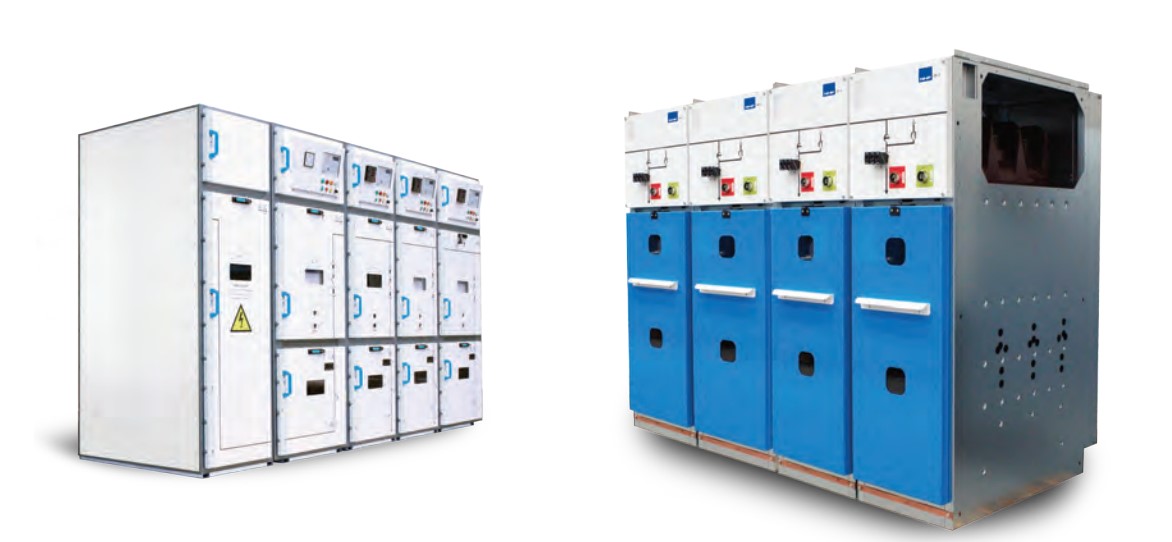
Modern medium voltage switchgear cubicles have been designed to mitigate the effects of internal arc faults and therefore protect both the operator and the installation; reducing serious injury and extended loss of availability should a problem occur. Internal arc faults are confined within the faulted compartment. There is no risk to adjacent switchgear compartments or operators in the vicinity of the switchgear. Damage is limited, and repairs can be swiftly completed and the electrical supply restored following a switchgear fault.
Switchgear is arranged in discrete tiers. Each switchgear tier is fitted with a load break isolator and interlocked earth switch to allow the individual tier to be isolated and earthed. Safety interlocks ensure that no access to the live parts of switchgear is possible. After the switchgear has been isolated and earthed, a risk assessment can be carried out and testing done to check the condition of the switchgear and cabling. If the tests reveal that maintenance or repair work is necessary, this may be carried out without the need to isolate the complete switchboard.
The protection, isolation, earthing and re-energisation can be carried out from a remote position, with the operator completely removed from any possible danger. The switchgear is made up from modular metal compartments. When combined with a relief chamber at the rear of the switchboard, the superheated gas plasma and incandescent expanding metal droplets generated by an arc fault are diverted away from the front of the switchboard.
By diverting the arc fault products to a relief chamber, damage to adjacent modules and the switchroom is minimised, as the rapidly rising pressure of the expanding gases is allowed to escape via the switchboard over pressure relief vents. As a result, the damage caused by the explosive force of the hot gasses in a switchroom can be reduced to a much lower level.
BENEFITS OF MODERN SWITCHGEAR CONT’
The switchgear cubicles are tested to ensure that an operator is protected against the consequences of an arc fault whether they stand in front of the switchboard, next to it, or behind it. Cubicles fitted with arc –killers (arc quenching system) take arc fault safety to a higher level. The operator and the environment are shielded from harm. The super swift arc extinguishing system allows cubicles to be inspected and quickly returned to service following an internal arc fault.
Arc- killers are an improved security feature which protect the switchgear and also reduce blast damage to switchrooms caused by the expanding gas high pressures generated by arc faults.
PROTECTION
Electro-mechanical protection relays installed over 25 years ago rely upon oil filled dashpot timers, rotating discs with jewelled bearings, attracted armatures and magnetic coils. These are precision devices whose origins stem from the early clock and watchmaking industry. Like the bulk oil filled circuit breakers they have to be maintained by specially trained technicians and instrument fitters, whose skills are scarce and disappearing. Electro-mechanical protection relays are prone to failure caused by the effects of dust, vibration, temperature, bearing wear, incorrect lubrication and age; regular servicing is essential.
Modern electronic protection relays provide superior protection for switchgear, transformers and cable networks. They rely on digital electronics and micro-processors to constantly monitor and detect changes in the electrical system. These relays are more sensitive and much quicker at responding to fault events than the older rotating disc or electromechanical relays. When used in conjunction with modern circuit breakers the switchgear and relay combination virtually eliminate damage caused by internal and cable faults in substations.
Digital protection relays reduce the risk of catastrophic failure, personnel injury and financial loss. Updating your switchgear installation will help mitigate your risk and may be advantageous when negotiating your insurance premiums.
WHERE TO FROM HERE?
If you have any concerns or doubts about your current installation NHP can arrange for a inspection and or detailed audit of your switch rooms and switchgear, for further information please contact:
Vince Grillinzoni 0438 500 029, Kim Kamat 0437 631 994 or John Kirkland 0418 989 428
NHP acknowledge the contribution of Andrew McGill-Morton of McGill-Morton and Associates Pty Ltd. for producing this paper. Andrew can be contacted on 0412 192 636.